- 7ACAF469539AE5BE731ED4CC5FA1B148

Amazon

Showing posts with label Circuit Breaker. Show all posts

PROPERTIES AND USES OF SF6 GAS

PROPERTIES OF SF6 GAS: 
SF6 structure
SF6 Structure

Sulfur hexa-fluoride (SF6): Sulfur hexa-fluoride gas is a chemically stable and inert gas (up to 500°C).
It is available in gas form at normal temperature and pressure (NTP) and in liquid form when temperature less than 10°C.The central atom of sulfur hexa-fluoride gas is sulfur atom and surrounded by six fluorine atom.

The properties of Sulfur hexa-fluoride (SF6) is given below:
  • Its density is five times higher than air.
  • It is non-inflamable.
  • It is colorless.
  • It is odorless.
  • It is non-poisonous.But it is toxic in impure form.
  • It has high insulating property.
  • It has cooling property.
  • It has high dielectric strength at high pressure.
  • It has arc extinguishing property.
  • It is thermally stable.
  • It has low arc-time constant.So, it extinguish the arc instantly.
  • It has high heat convention property.
Uses of Sulfur hexa-fluoride (SF6): Due to above given properties it is mainly used in electrical equipment.It is used in switch gears, circuit breakers, current transformers, bushing, cables, capacitors etc.It is used for electrical equipment those work on 3.6 KV to 765 KV.

Advantages of Sulfur hexa-fluoride (SF6) gas contain electrical equipment: The advantages of sulfur hexa-fluoride gas contain electric equipment is given below:
  • Compactness: This type of equipment compact in size as compare to other type of equipment ( vacuum, oil, air type etc).Thus it saves the installation land cost.
  • Maintenance free: This type of equipment is maintenance free.Only the visual checking of gas monitoring system of equipment is necessary.
  • Less installation time: Due to compact size.This type of equipment required less installation time in comparison to other type of equipment.Thus it also reduces the installation cost.
  • High safety factor: In this type of equipment all the metal part of the equipment earthed.So, the safety factor of this type of equipment is high.
More information about Earthing in electrical system click on the link.

Disadvantages of Sulfur hexa-fluoride (SF6) gas contain electrical equipment: The disadvantages of sulfur hexa-fluoride gas contain electric equipment is given below:
  • High initial cost: The cost of this type of equipment is higher than other type of equipment.
  • Difficult repairing work: The repairing work of this type of equipment is difficult and it takes long time.
  • Requirement of cleanliness: This type of equipment required more cleanliness.Because due to the dust particle and moisture, flash-over may be occur.
  • Problem of gas procurement: There is lot of difficulties in procuring and storing of Sulfur hexa-fluoride (SF6) gas.
Conclusion: Due to high dielectric strength and non-inflamable property.It is mainly used in electric system.In the world most of the country used SF6 gas contain electric equipment.
 

TYPES OF CIRCUIT BREAKER AND ITS RATING

DIFFERENT TYPES OF CIRCUIT BREAKER AND ITS RATING:

Different type of circuit breaker is given below:

  1. Air circuit breaker (ACB)
  2. Air blast circuit breaker (ABCB)
  3. Water circuit breaker (WCB)
  4. Oil circuit breaker (OCB)
  5. Vacuum circuit breaker (VCB)
  6. Sulfur hexafluoride (SF6) breaker 
We can read the basic principal and working of circuit breaker on clicking this link.

1.Air circuit breaker (acb): In this type of circuit breaker the arc quenching medium is air.
Air circuit breaker
Air circuit breaker

Operation: In this type of circuit breaker, when the circuit breaker operate means contact of circuit breaker separate.Then arc produced between contact.Due to the movable contact of circuit breaker, it increases the arc length.Thus arc suppressed between contact in the presence of arc.
The mechanical life = 5 lac operation
Rating of air circuit breaker: This type of circuit breaker used in both AC and DC.This is used for low voltage (up to 6.6 KV).
Features: The features of air circuit breaker is given below:
  • The installation of air circuit breaker is economical and easy.
  • The design of circuit breaker is very simple.
  • The operation of circuit breaker is easy.
  • The maintenance cost is less.
Drawbacks: The drawbacks of air circuit breaker is given below:
  • It is mainly designed for low voltage.
  • It is used in closed place.
2.Air blast circuit breaker (abcb): In this type of circuit breaker the arc quenching medium is fast blow compressed air between the contacts.
Air blast circuit breaker

Operation: In this type of circuit breaker, when the circuit breaker operate means contact of circuit breaker separate.Then arc produced between contact.Due to fast blow of compressed air between contacts, it suppress the arc between contact.The air blow between contact may be axial, radial or cross blast according to the construction of circuit breaker.The compressed area is collected in a tank and its pressure range is 85 to 175 kg/cm square.
The mechanical life = 5 lac operation
Rating of air blast circuit breaker: This circuit breaker used in the voltage range of 6.6 KV to 400 KV.
Features: The features of air circuit breaker is given below:
  • The operating speed is high.
  • It reduces the risk of fire.
  • The extinguishing of arc easily take place.
  • The maintenance cost is less as compared to oil circuit breaker.
Drawbacks: The drawbacks of air circuit breaker is given below:
  • The air - compressor is require.
  • More possibility of re-striking voltage. 
  • More possibility of over voltage, due to current chopping.
3.Water circuit breaker (wcb): In this type of circuit breaker the arc quenching medium is distilled water.
Water circuit breaker

Operation: In this type of circuit breaker, there are two parts.First is known as pressure chamber in which fixed contact situated.Second is known as pressure chamber in which movable contact situated.When the circuit breaker operate means contact of circuit breaker separate.Then arc and heat produced between contact.This heat vapourise the water and this water vapours increases the pressure in bottom chamber.So, this chamber is known as pressure chamber.
When moving contact move, the vapour comes between the contact and suppress the arc.After extinguishing arc it condense and expand in upper chamber.So, this chamber is known as expansion chamber.
Rating of water circuit breaker: It is used for low voltage (up to 6.6 KV) for low current carrying circuit.
Features: The features of air circuit breaker is given below:
  • It is compact in size as compare to oil circuit breaker for same rating.
Drawbacks: The drawbacks of air circuit breaker is given below:
  • Maintenance cost is high.
  • It is used in low current carrying circuit.
Oil circuit breaker (ocb): In this type of circuit breaker arc quenching medium is oil (dielectric oil, transformer).
We can read the properties of transformer oil on clicking this link.
Oil circuit breaker

Operation: In this type of circuit breaker fixed and movable contact situated in oil tank.When the circuit breaker operate means contact of circuit breaker separate.Then oil comes between these contacts and extinguish the arc and also provide cooling.
Rating of oil circuit breaker: Due to high breaking capacity.This type of circuit breaker used up to 220 KV.
Features: The features of air circuit breaker is given below:
  • The oil provide insulation between contact and tank body.
  • The oil provide cooling.
  • The oil transfer the heat.
  • The cost of oil circuit breaker is less as compared to air circuit breaker.
Drawbacks: The drawbacks of air circuit breaker is given below:
  • The installation and maintenance cost is high.
  • The oil contain moisture at rainy season.Due to this dielectric strength of oil decreases.
  • The testing of oil is necessary after 1 year.
  • Periodically inspection is necessary.
Vacuum circuit breaker (vcb): In this type of circuit breaker the arc is extinguish in vacuum.
Vacuum circuit breaker

Operation: In this type of circuit breaker the fixed and movable contact situated in a chamber.This chamber is known as vacuum interrupter (in which closing or opening of circuit breaker take place).When the circuit breaker operate means contact of circuit breaker separate.Then arc produced between contact is suppress in vacuum interrupter.
The mechanical life = 5 lac operation
Rating of vacuum circuit breaker: The vacuum circuit breaker is mainly used for 11 KV, 33 KV (rms voltage).
Features: The features of air circuit breaker is given below:
  • It is compact in size.
  • It can be operated in open as well as closed place.
  • Less maintenance required.
  • High operating speed.
  • It is more reliable.
  • High making and breaking capacity as comparison to air circuit breaker, oil circuit breaker.
Drawbacks: The drawbacks of air circuit breaker is given below:
  • We cannot check vacuum in interrupter without test.
Sulfur hexa fluoride (SF6) breaker: In this type of circuit breaker arc extinguishing medium is sulfur hexa fluoride gas.
More information about Sulfur hexa fluoride (SF6) gas click on given link.
sf6 breaker
SF6 breaker

Operation: In this type of circuit breaker fixed and movable contact situated in a chamber that is filled with sulfur hexa fluoride gas.When the circuit breaker operate means contact of circuit breaker separate.Then arc produced between contact is suppress by sulfur hexa fluoride gas in chamber.
Rating of vacuum circuit breaker: This circuit breaker is used up to 750 KV.
Features: The features of air circuit breaker is given below:
  • It is compact in size.
  • It can be operated in open as well as closed place.
  • Less maintenance required.
  • High operating speed.
  • It is more reliable.
  • High making and breaking capacity as comparison to air circuit breaker, oil circuit breaker.
Drawbacks: The drawbacks of air circuit breaker is given below:
  • High initial cost.
  • Problem of gas procurement.
  • Difficult repairing work.
Conclusion: The final conclusion is that circuit breaker is necessary for electric circuits.But at the time of selection of circuit breaker, we should keep some point in mind like rating, cost, installation place, type etc.


CIRCUIT BREAKER OPERATION

WHAT IS CIRCUIT BREAKER AND BASIC PRINCIPAL?

Circuit Breaker: It is a device that close or open the electrical contact in a chamber (interrupter) in normal as well as abnormal (fault) condition.

OR

A device that isolate the electrical equipment (transformer, generator etc) by breaking the contact from faulty circuit.
Circuit breaker panels
Basic principal of operation of circuit breaker:
The working principal of circuit breaker can be explain by given two parts:
1.Opening of contacts of circuit breaker
2.Extinguishing of arc produce between contacts.

Working diagram circuit breaker
1.Opening of contacts: The circuit breaker always connected in series with circuit.As shown in figure, circuit breaker has a moving contact in which one end is fixed and another end is movable.A handle is also attached with movable end.The circuit breaker can be operate manually or automatic.For automatic operation a device is connected with circuit breaker.
According to figure the trip coil is connected with current transformer and it is also connected with automatic operated device (for automatic operation of circuit breaker).In normal condition current flow from circuit.When the current above normal condition (at the time of fault), then current transformer excited and the increase current also flow in trip circuit.Thus trip coil energized and it attract the mechanical device and the handle connected with movable end move (as shown in figure) and it disconnect from fix end, thus it is break the circuit.

2.Extinguishing of arc: When the contact of circuit breaker opened, then a high current flow between contact, that produce spark and heat between the contact.Due this the air or oil between the contact ionized.Thus resistance between contact decreases and voltage drop across contact also decreases.Thus spark between the contact increases gradually.So, it is important to stop the arc at this time.Because if it persists for some time, it may be become more dangerous.

The extinguishing of arc in circuit breaker take place by given method:
1.High resistance method: In this method the arc is extinguish by increasing the resistance between contact.This method is used in low and medium voltage air circuit breaker.It is also used in DC circuit breakers.The following methods is used for increasing the resistance between contacts:
a) Reducing ionized particles: The ionization of air or oil depends upon the potential gradient and temperature between contacts.So, by decreasing the potential gradient and temperature between contact we can reduce the ionization of particles.We can reduce potential gradient by increasing the distance between contacts.By cooling the arc we can decrease the temperature between contacts.
b) Increasing the length of arc: We know that resistance is directly proportional to length.Thus by increasing the length between contacts.The length of produce arc increases.So, resistance between contact increases and it extinguish the arc.
c) Decreasing the cross section area of the arc: We know that resistance is inversely proportional to cross section area.So, by using thin contacts we can decrease the cross section area of arc.Thus the arc suppress easily.
d) Splitting the arc: By inserting conducting plates between produce arc.We can split the arc.Thus arc extinguishes easily.

2.Low resistance method: This method is used for AC circuit breakers only.Because in this method the arc is suppress at the time of zero condition of AC.Thus it does not re-strike to produce arc again.It is also know as ZERO POINT method.
In this method between the arc produces between contact is cooled by the acceleration of pressure free air or gas.So, the air or oil between the contact is not ionized by arc.
→This method is used for high capacity breakers.

Desired requirements in circuit breaker: The desired requirements in circuit breaker is given below.
1.Safety: It should be work properly in normal and abnormal condition.
2.Quickness: It should be work quickly.At the time of fault it should be break the faulty circuit quickly.
3.Selectivity: At the time of abnormal (fault) condition, it should be break the only faulty circuit without disturbing the normal circuits.
4.Reliability: It should be operate only in fault condition.
5.Sensitivity: It should be sensitive for fault.At the time of fault it should be operates quickly.

Duties of circuit breaker: The duties of circuit breaker is given below.
1.It should be work properly on full load (without rise the temperature).
2.It should be open and close on no load.
3.It should be operate at time of fault.
4.At normal condition, it should be open and close.

Conclusion: The final conclusion is that circuit breaker behaves like a switch as well as a protective device.With the help of circuit breaker we can open or close the circuit at normal condition and at time of fault it operates quickly and protect the electrical system.

Important links:

ACCESSORIES AT CIRCUIT BREAKER PANEL

DIFFERENT ACCESSORIES MOUNTED ON CIRCUIT BREAKER PANEL AND ITS SUPPLY:

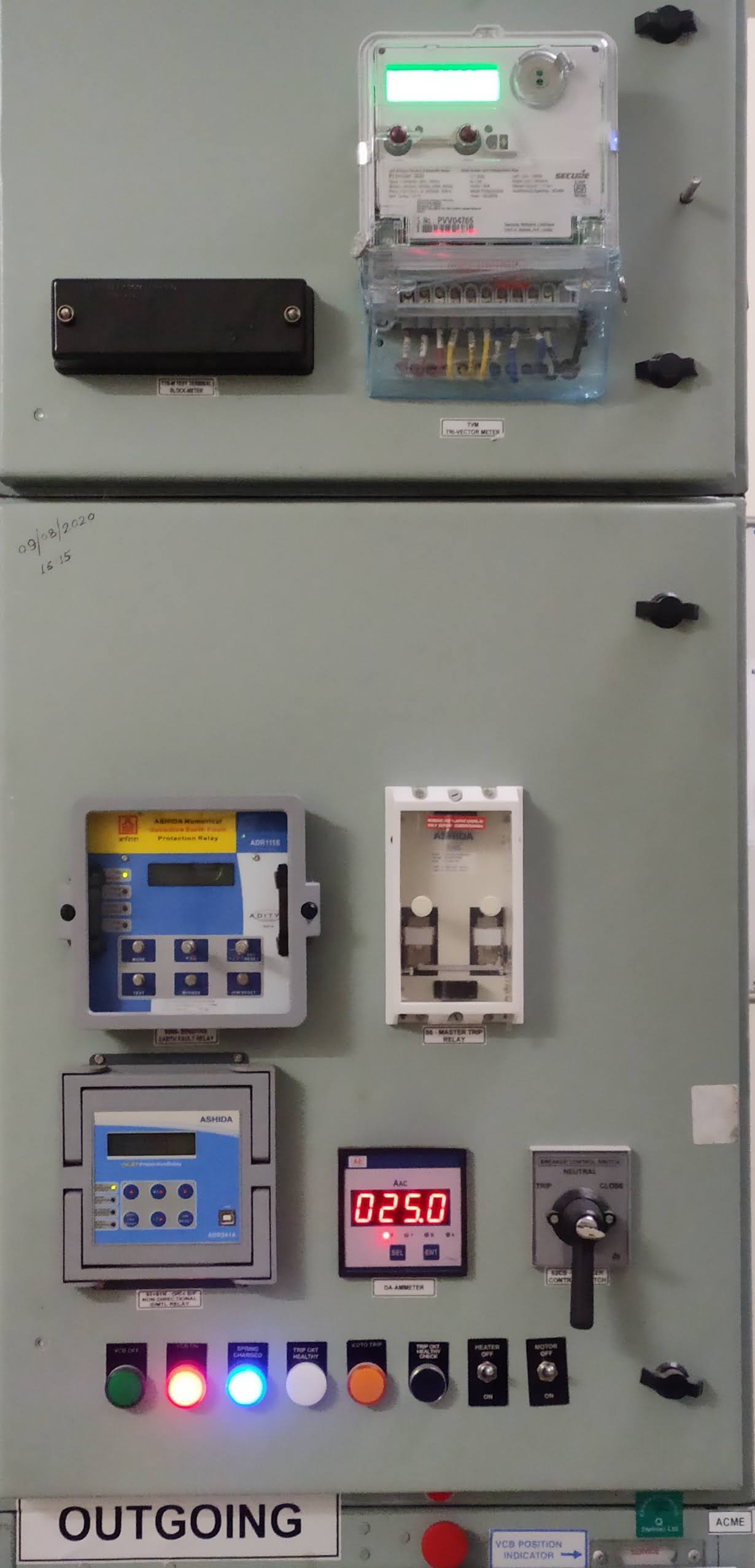
The different type of accessories that is mounted on circuit breaker and its supply is given below.The knowledge of supply of different accessories is very necessary because it is very helpful for checking and maintaining the accessories when it is faulty.These accessories mainly works on 230V AC or 220V DC/24 DC.So we discuss about the supply of different accessories one by one.

Circuit breaker panel
Circuit Breaker Panel

Firstly we discuss about indication lamps and push buttons that is shown in above image.

1.GREEN LAMP: If it glow it shows breaker in OFF condition means not in service.The supply given to green lamp is 230V AC.

2.RED LAMP: It is glow when breaker is ON condition means breaker is in service.The supply given to red lamp is 230V AC.

3.BLUE LAMP: If it glow it shows our circuit breaker spring charging motor is fully charged.The supply given to blue lamp is 230V AC.

4.WHITE: If it glows on pressing push button than our trip circuit healthy means DC supply is presence up to shunt trip coil of CB and CB trip at time of fault.The supply given to white (trip circuit healthy) lamp is 220V/24V DC.

5.AMBER: If it glows means breaker is auto trip due to fault on feeder.The supply given to amber (auto trip) lamp is 220/24V DC.

6.CLEAR: At the time of DC fail means DC supply is not in CB.Than clear (DC fail) lamp glow.The supply given to clear lamp is 230V AC.

7.BLACK COLOR PUSH BUTTON: After pre-close and post close of CB this button is used.By using this button white lamp glow means it indicate our trip circuit healthy.Thus this button is used for trip circuit healthy check.

8.YELLOW COLOR PUSH BUTTON: At time of fault CB trip and thus alarm bell operate that indicate the CB trip.To stop this alarm bell we will push yellow color button.

9.RED COLOR PUSH BUTTON: When alarm operate the relay of alarm bell also operate.To reset the alarm bell relay we push red color button.

10.BLUE COLOR PUSH BUTTON: This button is used to check the DC fail in CB.

SWITCHES: The given below switches mounted on CB panel:

1.T-N-C SWITCH: This switch is used to close or trip the circuit breaker.It has three position (Trip, neutral and close).This switch has pistol grip handle spring return to neutral means when we close or trip by the switch after operation switch handle comes to neutral.The supply given to switch is 220/24V DC.

2.TOGGLE SWITCH: There is two toggle switch mounted on CB panel.This switch is used for heater and spring charging motor.The supply given to toggle switch is 230V AC.

METERS: The given below meters mounted on CB panel:

1.Digital Voltmeter: This meter show the input voltage of the CB.Inbuilt selector switch is also present in this meter.With the help of this switch we can check line as well as phase voltage.The input supply given to this meter is 230V AC.

2.Digital Ammeter: This meter shows the output current(load) on the CB.With the help of  inbuilt selector switch we can check line as well phase current.The input supply given to this meter is 230V AC.

(For more information see the topic digital ammeter and voltmeter reading setting topic in this site).

3.Power factor meter: This meter shows the power factor of the load.The supply given to this meter is 230V AC.

4.Solid state trivector meter: This meter given KWH, KVAH, KVAR reading of the load.The supply given to this meter is 110V (PT Secondary supply 110V).

BELL AND BUZZER:

1.Bell/Hooter (Trip alarm): Bell is a tripping alarm means it will operate when breaker is trip.The input supply of bell is 220V/24V DC.Due to operation of given below relay CB trip and alarm/hooter operate.

1.HV restricted earth fault relay

2.Transformer Pressure release valve trip

3.Transformer winding temperature trip

4.Transformer oil temperature trip

5.Transformer buchholz trip main

6.On load tap changer (OLTC) PRV trip

7.Differential relay

8.O/C and E/F relay

9.Master trip relay

10.Back O/C and E/F relay operated

11.Over flux relay

Relay indication

Relay indication

2.Buzzer: It is a non tripping alarm means at this time breaker is in on condition (service).It operates when panel DC fail.The input supply given to buzzer is 230V AC.

3.Bell/hooter (Non-trip alarm): This bell/hooter operate at that time when CB is not trip.This alarm operate when given below relay will operate.

1.Transformer oil temperature high alarm

2.Transformer buchholz alarm main

3.Transformer low oil level alarm

4.Transformer winding temperature high alarm

5.AC supply fail relay

6.Faulty master trip relay

RELAYS: In this topic we only discuss about different relay input supply.In next topic we discuss one by one about the different relay.The supply given to different relay is given below:

1.Non directional IDMT relay (51+51N) O/C & E/F = 220V/24V DC

2.Restricted earth fault relay (REF) = 220V/24V DC

3.Sensitive earth fault relay = 220V/24V DC

4.Mater trip relay = 220V/24V DC

5.Inverse time under voltage, over voltage & Neutral displacement relay = 220V/24V DC

6.Time delay relay = 220V/24V DC


Important links:

different term regarding circuit breaker rating?

operating duty of circuit breaker?


DUTY CYCLE OF CIRCUIT BREAKER

WHAT IS OPERATING DUTY CYCLE OF CIRCUIT BREAKER? 

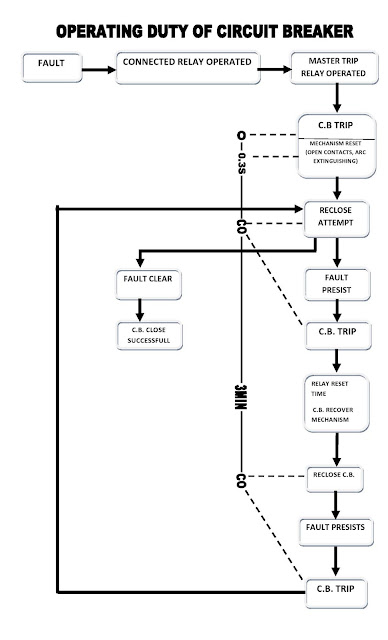
Operating duty of circuit breaker terms related to opening, closing sequence of circuit breaker.
We always see a term on circuit breaker rating plate operating duty and it is written as:

OPERATING DUTY:  O-0.3 sec-CO-3 min-CO
O: OPEN
C: CLOSE


Time sequence of operating duty of CB

The above terms relate the opening,closing sequence of circuit breaker.

Operating duty chart of CB
                                             
According to above diagram if fault occur on feeder than the relay connected on circuit breaker operated and at that time master trip relay operated and it trip (open) the breaker.
          And after 0.3 sec we can re-close the CB (circuit breaker):
1.If fault clear than closing of CB is successful.
2.If fault present at feeder CB trips instantly means re-closing of CB is unsuccessful.
This 0.3 sec is the time taken by the CB to recovering mechanism (contact open in chamber,arc extinguishing in chamber).


According to duty cycle after 3 minute we take second try(re-closing of CB),this is the relay reset time and breaker mechanism recover time.
If fault persists than circuit breaker relays operate and trip the circuit breaker instantly and this sequence follow for the smooth operation of circuit breaker and next re-closings done after 3 minutes as shown in diagram.

The knowledge of operating duty cycle of circuit breaker is very necessary.The following advantages of knowledge of operating duty cycle given below:
1.It increase the life period circuit breaker.
2.Reduce the maintenance cost.
3.Reduce any electrical and structure damage of CB.
4.Increases the life period of relay.

Important links:

TERM RELATED TO CIRCUIT BREAKER

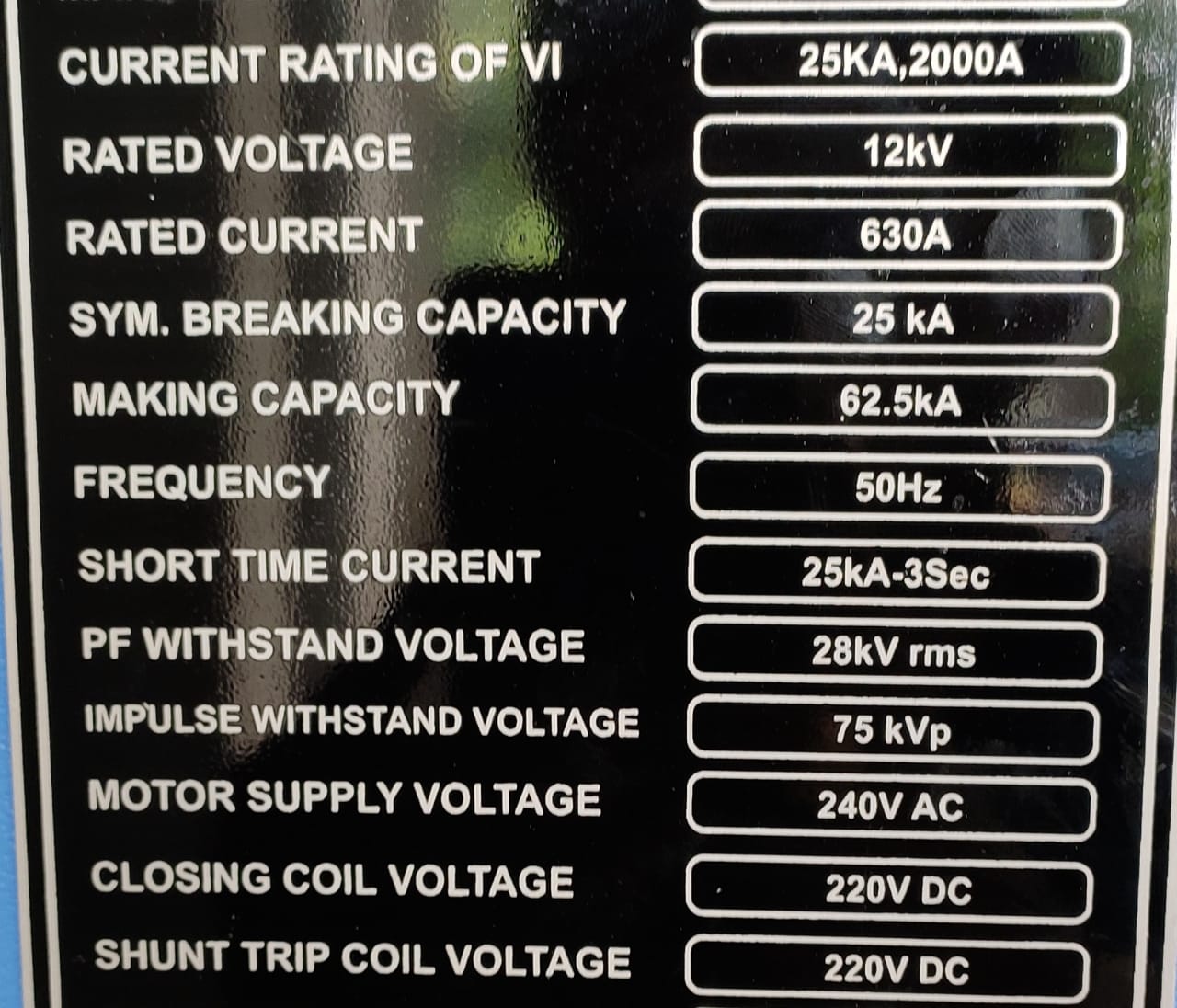
 TERM RELATED TO 11 KV CIRCUIT BREAKER RATING:

1.RATED VOLTAGE: It is the maximum rms voltage on which circuit breaker can works normally.

 ex: Rated voltage: 12 KV means circuit breaker works normally up to 12 KVrms voltage.

2.RATED CURRENT: It is the maximum rms current on which circuit breaker can works normally.

ex: Rated current: 630 A means circuit breaker can work normally up to 630 A.

3.RATED FREQUENCY: Rated frequency of a circuit breaker is the frequency at which it is designed to operate.

ex: Rated frequency: 50 Hz

4.PF WITHSTAND VOLTAGE: It is the rms value of sinusoidal power frequency voltage that the electrical equipment shall withstand for a specific period of time normally 01 minute.

ex: PF withstand voltage: 28 KVrms

5.SHORT TIME CURRENT: It is the ability of circuit breaker to withstand for a short time duration under high fault condition.

ex: 25 kA for 3 sec means this circuit breaker withstand for 3 sec up to 25 kA high fault current.

6.IMPULSE WITH STAND VOLTAGE: It is the peak value of impulse voltage (lighting, over voltage) on which circuit breaker capable of withstand without failure.

ex: Impulse withstand voltage: 75 kVp

7.MAKING CAPACITY: It is the maximum peak value of the current that the circuit breaker can interrupt without any damage if the breaker is closed at fault.

Making current > Breaking current

Making current = 2.55*symmetrical breaking current

ex: Making capacity: 62.5 kA

8.SYM. BREAKING CAPACITY: It is the level of current at which the circuit breaker can interrupt without any damage.

Breaking current = 1.8*1.41*Irms

rating plate of circuit breaker
Rating plate circuit breaker


ex: Sym. breaking capacity: 25 kA

9.MOTOR SUPPLY: It is the voltage at which spring charging motor of circuit breaker work.

ex: 240V AC

10.SHUNT TRIP/CLOSE COIL: It is the voltage at which circuit breaker shunt trip/close coil works.

ex: 220V DC

11.BUS BAR RATING: It is the maximum value of bus bar current on which circuit breaker connected.

ex: 1250 A

12.SERIAL NO.: It is used by manufacture for identity.

Important links:

Accessories at circuit breaker panel?

Operating duty of circuit breaker?


Coupon

Popular Posts